Life does not always deal fairly. There are seasons when everything feels heavy, uncertain, or simply unjust — when the effort you put in seems to return nothing, when the people you trusted disappoint you, when the world shows no particular interest in your suffering. In those moments, the easiest thing is to close off. To decide that softness is a liability. To protect yourself by becoming smaller, harder, more careful about where your care goes.
But something else is also possible. These 13 real-life moments show that compassion does not require a world that deserves it. It requires only a person willing to choose it, in the specific, concrete moment when the choice is available. None of these people were saints. None of them were operating from comfort or surplus. They chose kindness anyway, and in doing so, they changed the direction of a life — sometimes their own.
1. The scarf on the night train
On a cold night train, most passengers did what most passengers do — they looked away. A homeless man sat quietly in the corner, visibly freezing, and the carriage arranged itself around his presence as though he were a piece of furniture that had been left there by mistake. One businesswoman did not look away. She offered him her spare scarf. What began as a small gesture became a conversation. He told her how an injury had cost him his job; she listened without redirecting him toward solutions or hope he hadn’t asked for.
At the next station, she returned with food and a prepaid travel card. She also gave him a job contact, and told him to pass the kindness on someday. Months later, he was seen again — employed, composed, and still carrying the scarf. One hour of being seen had altered his path.
Research from the American Psychological Association consistently finds that perceived social support — the felt sense that someone is willing to help — is one of the strongest predictors of resilience in people experiencing hardship. The scarf was the opening. The listening was the support.
2. The retired teacher and the quiet room
A retired teacher noticed a teenager in her neighborhood who was avoiding going home. She could read the situation without being told — family conflict, the particular kind of rootlessness that comes from having nowhere safe to sit still. Instead of asking too many questions, she offered a practical thing: a place to study. No conditions. No requirement to explain.
Over time, the offer extended to temporary housing during exam periods. The teenager later earned a scholarship and publicly credited her. The teacher, when asked about it, said she had only provided quiet. That was enough. Sometimes the most powerful thing you can give someone is a room where nothing is required of them.
3. The stranger at the market who paid for more than groceries
At 79, one man was surviving on minimal food. His pension barely covered rent. Pride had kept him from asking for help, and hunger had become routine. At the market one afternoon, he found himself short for his groceries. A woman behind him quietly covered the difference. She didn’t make a show of it. She shared a brief story about her grandfather, which gave him somewhere to put his dignity — the story made the help feel like an exchange rather than a charity.
That day, he ate properly for the first time in weeks. He said afterward that the kindness felt more nourishing than the food itself. Not because the food wasn’t needed, but because being seen — by a stranger, with no prior claim on her care — restored something that hunger alone hadn’t taken.
4. The painting that arrived a week later
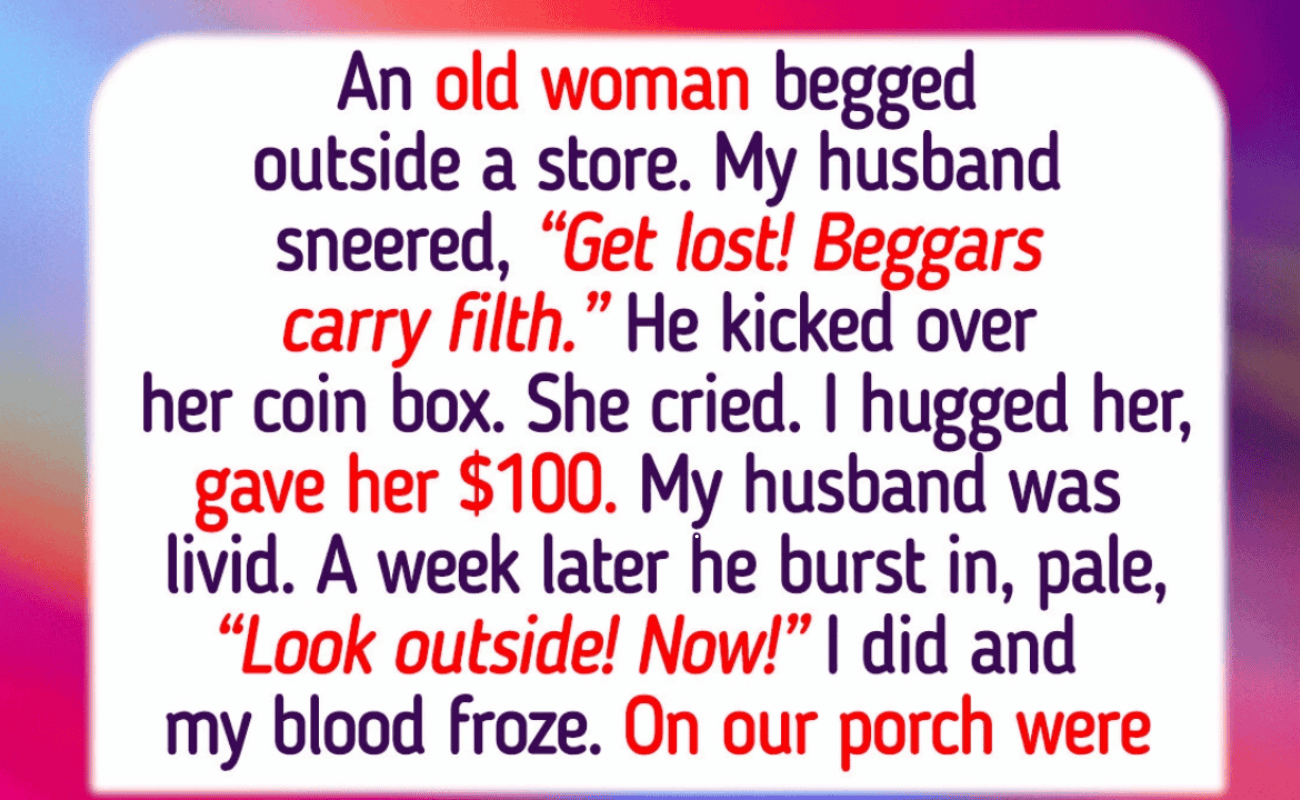
Outside a store, an elderly woman dropped her coins and asked for help. One person stopped and helped her; her partner reacted harshly. A week later, a painting appeared at their door. It depicted a meaningful moment from their shared past — but with a significant detail changed. The woman had painted the partner not as he had acted that day, but as the kind version of himself she had chosen to imagine.
This is a quietly radical act. She did not shame him. She offered him a version of himself that was better, and left it on the porch for him to find. Compassion, here, was not a response to what he had done — it was a vision of what he could be. Sometimes that is the more generous thing.
5. The headphones on the crowded bus
A woman was caring for her sick father while managing personal struggles she had kept entirely hidden. The weight of it finally broke through one morning on a crowded bus. She began to cry in public, which is one of the more exposing things a person can do — surrounded by strangers with nowhere to go. Most passengers looked away. A young man nearby did something different. He offered her his headphones and played calming music. He asked no questions. He offered no advice. He simply sat beside her and shared a quiet moment.
That silent support helped her regain control. She described it afterward as the reminder that kindness is sometimes just allowing someone space to exist without judgment. The young man didn’t fix anything. He stayed. That was the whole of it.
Psychology Today’s research on empathic presence distinguishes between fixing and witnessing — the capacity to be with someone in pain without needing to resolve it. The second, it turns out, is often more therapeutically valuable than the first.
6. The stepbrother who used his vacation days
Two stepbrothers had spent years competing over perceived favoritism. As adults, they barely stayed in touch. When one of them faced a difficult custody battle — financially draining, emotionally exhausting, legally complex — the other stepped in without being asked. He handled errands, managed daily responsibilities, attended hearings, and used the vacation days he had been saving for himself. He never mentioned the sacrifice.
His steady presence allowed his stepbrother to focus on what mattered. The custody case was won. And the years of resentment — not addressed directly, not discussed, but quietly superseded by the evidence of what this man had chosen to do — dissolved into something that looked, from the outside, like the beginning of a real relationship.
7. The teenager on the staircase
At sixteen, one young person was failing school, working evenings to survive, and hiding a parent’s repeated hospitalizations. The performance of being fine had become a full-time occupation on top of everything else. One night, the exhaustion finally won — they fainted on a staircase. One passerby dismissed it as attention-seeking, which added humiliation to the physical distress. A second person rushed over.
She gave water, food, and stayed until they recovered. She didn’t stop there — she helped connect them to a social worker who provided the structural support that a single act of kindness couldn’t sustain on its own. What that moment restored wasn’t only physical. It restored the belief that strangers could be allies rather than threats, which is not a small thing for a sixteen-year-old managing everything alone.
8. The siblings and the custody battle
Siblings who had grown up with unequal parental attention often carry the accounting of it into adulthood. One sibling had spent years carrying resentment toward a younger brother who had, in their perception, been favored and depended heavily on others. The distance between them had widened over time, and neither had made significant moves to close it.
When the younger brother faced a brutal custody battle, the older one made a decision that bypassed the history entirely. They handled paperwork, attended court hearings, and took unpaid leave at personal career risk. After months of effort, the brother regained stability. And in the shared experience of that difficulty — not in any conversation about the past, but in the action of being present for it — gratitude replaced years of tension. Their relationship found a new beginning through the oldest route: showing up when it counted.
9. The mother who backed the supplier deal without saying so
After years of distance from family, one person was struggling with a failing business. Help came unexpectedly and quietly: a supplier offered flexible terms that made survival possible. It was only later revealed that the person’s mother had privately backed the agreement — had put herself forward in some form to make the arrangement possible, and had never mentioned it.
She didn’t want credit. She wanted her child’s business to survive. The love expressed here is of a specific and quietly remarkable kind: the kind that acts behind the scenes, that doesn’t require acknowledgment, that finds a way to help without making the helped person feel the weight of the help. Her actions spoke with a clarity that a conversation might have muddied.
10. The sisters who found each other in the caregiving
Parental favoritism is one of the more corrosive forces in sibling relationships because it is rarely acknowledged and almost never resolved. Two sisters had grown into adults carrying its weight. When their mother became seriously ill, the less-favored sister took on the caregiving responsibilities, despite the old resentment she had every reason to act on. The favored sister initially withdrew — not out of cruelty, but out of fear she couldn’t manage.
Eventually she returned, rearranging her life to share the burden. She admitted, for the first time, what had held her back. They worked together without revisiting the past. The shared experience didn’t erase the history. But it reshaped the future — and the relationship found a new structure built on what they had chosen to do for each other rather than what had been done to them.
11. The nurse in the hospital waiting room
Hospital waiting rooms are designed for endurance rather than comfort. They ask people to manage fear in a public space with strangers, under fluorescent lights, for indeterminate periods of time. One nurse — working a long shift, already stretched — noticed a family in visible distress and chose not to move past them. She offered reassurance, helped with paperwork, and provided the specific small comforts that transform a clinical environment from something hostile into something merely difficult.
That kindness created a sense of safety during a moment of extreme vulnerability. It didn’t change the medical outcome. It changed the experience of waiting for it — and experience is not a small thing when fear is the primary content of every minute.
Research published in the Journal of Patient Experience has consistently found that perceived compassion from healthcare providers significantly reduces patient anxiety and improves outcomes — not because kindness is medical intervention, but because it alters the physiological state in which patients receive care.
12. The sixteen-year-old who needed one person to stay
A different sixteen-year-old was overwhelmed by school failure and the specific exhaustion of hiding a parent’s illness from everyone around them. The collapse, when it came, happened on a staircase in public. The first person to respond dismissed the situation and added humiliation to the distress. The second person — a woman who happened to be passing — made a different choice.
She gave water and food. She stayed until the teenager had recovered. And she came back — not just in that moment but in a sustained way, helping connect them to services that provided the kind of structured support that a single act of kindness cannot permanently sustain. The moment didn’t just help physically. It restored faith in the idea that someone might choose to care about a stranger. Which is, for a teenager managing everything alone, a foundational piece of evidence about what the world is like.
13. The neighbors who fixed the air conditioner
During a scorching heatwave, a widowed grandmother was struggling to cool her home for her three young grandchildren. Her air conditioner had broken. Neighbors became aware of the situation and quietly assessed the problem. While she was out, they repaired the wiring, installed a new unit, and cleaned up so thoroughly that nothing appeared to have been done. They presented it, when she noticed, as routine maintenance — the kind of thing that just sometimes gets handled.
She accepted the explanation graciously, which may have been its own act of kindness — allowing the neighbors the dignity of their anonymity. What resulted was not just a cooler apartment. The building became a closer community. Anonymous interventions of this kind have a specific quality: they give without requiring the recipient to navigate the discomfort of gratitude. The help is simply there. That is a sophisticated form of compassion.
What these moments have in common
None of these people were operating from surplus. None of them were in positions of particular power or comfort when they chose to act. The businesswoman on the train had her own schedule. The retired teacher had her own life. The stepbrother had vacation days he had earned and was saving for himself. What they shared was a willingness, in a specific moment, to let the need in front of them be more pressing than their own convenience.
Research from the Greater Good Science Center at UC Berkeley has documented what psychologists call the “helper’s high” — the neurological and emotional reward that follows an act of genuine compassion. But more significantly, their research suggests that compassionate action produces cascading effects: recipients of kindness are measurably more likely to extend it to others, creating the kind of ripple that most of these stories eventually describe.
None of these acts required extraordinary resources. They required attention — the willingness to notice, and then the decision to respond rather than move on. The woman who noticed the homeless man was shivering. The teacher who noticed the teenager avoiding home. The young man on the bus who noticed the woman was crying. Attention is the precondition. Everything else follows from it.
Final thoughts
Life often tests people in unexpected ways. It creates moments of pain, distance, and uncertainty. But as these stories show, kindness has a unique ability to bridge those gaps. Even in a world that can feel unforgiving, compassion remains one of the most powerful forces available to ordinary people in ordinary moments.
The most important detail in each of these stories is not the scale of the gesture. It is the choosing of it. These people were not required to stop. They were not compelled by obligation or circumstance. They simply decided — in the specific moment when a different decision was entirely available to them — that the person in front of them mattered enough to act.